For the majority of people, the biggest prospective source of radon direct exposure is in their house. You can check radon levels in your house to figure out if you need to take steps to lower them.
Would you buy a house with radon?
Radon is a naturally occurring radioactive gas which may be found in indoor environments such as homes, schools, and workplaces. Radon is the most important cause of lung cancer after smoking.
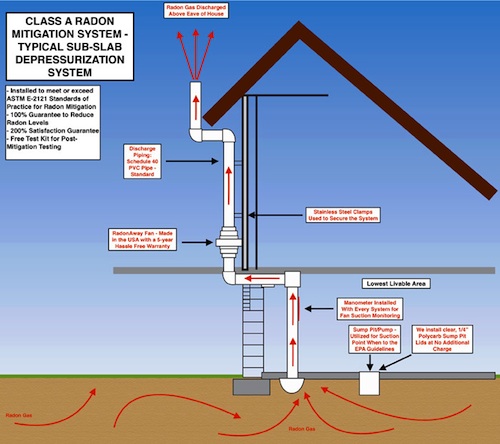
ASD systems can be adapted for usage with all structure kinds (cellar, slab-on-grade, crawl space, or mixed foundation types) and is one of the most affordable and most effective ways of reducing raised indoor radon. As the air in your home warms, it climbs to leak out the attic openings and around the top flooring home windows. This creates a tiny suction at the lowest level of the house, pulling the radon out of the soil and into the house. You can check this on a cold day by opening a leading flooring window an inch. You will observe cozy air from your home rushing out that opening; yet, if you open up a cellar home window an inch, you will feel the cold outside air rushing in.

These are small, heavy, electrically billed, sub-atomic bits containing 2 protons as well as 2 neutrons. If an alpha particle strikes the chromosomes in a lung cell, it might alter the manner in which cell reproduces. Our body's body immune system must identify and destroy these mutant cells prior to they can multiply over the following 10 to two decades into an identifiable cancerous development. The primary approach of radon reduction (or reduction) includes the installation of an Active Soil Depressurization (ASD) system. An ASD system entails the installment of a venting system that gets rid of radon gas from the dirt below a home's structure.
How bad is a radon level of 8?
The EPA strongly recommends radon mitigation if your radon levels are above 4 pCi/L. While radon levels below 4 still pose a health risk. They recommend you consider mitigation if your radon levels are between 2 and 4 pCi/L. They are quick to point out that there is no known safe level of radon.
Threat of death from lung cancer cells in a long-lasting non-smoker was negligible, and also just partially enhanced by radon direct exposure. Radon focus is highest possible inside, specifically in residences and little buildings. In the UK, the plan is for action to be absorbed the house when concentration goes to or above 200 becquerels (Bq) per cubic metre.
Does Radon make you tired?
The more uranium there is, the more radon there is. That makes radon the second leading cause of lung cancer after smoking. But even minor symptoms like headaches, feeling unusually tired, itching or burning eyes, irritated skin, nasal congestion, a dry throat or nausea could be due to your home's indoor air quality.
Radon, Smoking, as well as Lung Cancer: The Required to Redouble Radon Control Plan
Why is radon bad for you?
Radon produces a radioactive dust in the air we breathe. http://rylanpmyq976.yousher.com/radon-and-cancer The dust is trapped in our airways and emits radiation that damages the inside of our lungs. This damage, like the damage caused by smoking, increases our risk of lung cancer.
For this populace about 62 individuals in a 1,000 will pass away of lung-cancer, compared to 7.3 people in a 1,000 for never ever smokers. Rephrase, an individual who never ever smoked (never smoker) that is subjected to 1.3 pCi/L has a 2 in 1,000 possibility of lung cancer cells; while a cigarette smoker has a 20 in 1,000 opportunity of dying from lung cancer cells. You won't require any kind of significant restorations to deal with radon, yet it's not a diy task, either.
The Radon Department joined the 2020 National Radon Poster Contest, sponsored by the Conference of Radiation Control Program Supervisors (CRCPD). Pennsylvania pupils ages 9-14 years of ages were urged to develop an academic poster that reveals the physical aspects of radon, the unsafe results of indoor radon gas, or the relevance of screening for radon in the residence.
Info will be available as well as distributed by September 2020, with entries due in November 2020. If your home has elevated levels of radon, checking is the only way to understand. An easy home examination package can be bought at equipment or home improvement shops for around $20 to $30. Because radon levels are usually highest in the cellar, positioning your test there is a great suggestion. Nevertheless, radon levels can additionally be high over ground, also in homes without cellars, so the very beginning is likewise an excellent place to test.
What do you do if your house has radon?
Radon can seep into any home that is in contact with the ground. It is undetectable unless you perform a radon test. It is the second leading cause of lung cancer and according to the EPA and CDC, it kills more than 20,000 annually. It is not something you want in the home you are buying.
The pipe is then transmitted either up with the house and also exited via the roofing and the attic room or transmitted to the outside of the house and also up the wall with the terminus above the eave line of your home. If the vent pipeline is transmitted via the house, the suction follower is usually installed in the attic room. The follower is placed near ground degree if the vent pipe is directed up the exterior of the house. The system sign is mounted at some noticeable place listed below the suction follower. A lot of systems utilize an easy U-tube manometer to show that suction is being applied in the pipe by the suction fan.
What are the chances of getting lung cancer from radon?
Granite, like any other stone, may contain veins of naturally occurring radioactive elements like uranium, thorium, and their radioactive decay products. If present, uranium, thorium or radium will decay into radon, a colorless, odorless, radioactive gas that may cause lung cancer.
Individuals who do smoke and are subjected to high degrees of radon go to also greater risk. One of the largest troubles in the radon industry is follow-up testing. However, lots of people assume they are risk-free because they have a radon reduction system but have never ever done a radon test to make sure it's really working. Please make certain to do a radon test after a mitigation system is set up as well as additionally a minimum of every 2 years afterwards.
Can I install my own radon mitigation system?
In most cases, pros charge about $1,500 to install a radon mitigation system, but you can do it yourself for only about $500 in materials. So if you're fairly handy and have some carpentry, plumbing and electrical skills, you can install your own system what is radon testing nashville in a weekend and save yourself a thousand bucks!
- If you have questions concerning radon in your house, you can get aid from the EPA by calling RADON ().
- As a matter of fact, research study reveals that cigarette smokers are almost 7 times most likely to create lung cancer cells than nonsmokers when exposed to the same amount of radon.
- Nonetheless, these are normally not significant contributors to the radon degrees in a home.
Qualified professionals can be discovered through state radon offices, which are provided on the EPA internet site. As soon as you know your level, you can choose whether it's useful to install a radon reduction system.
How common is radon in a home?
It's common: About 1 in every 15 homes has what's considered an elevated radon level. The gas is odorless and invisible, says the EPA, and it causes no immediate symptoms, so the only way to know if your home is affected is by testing your individual residence.
How do I know if my house has radon?
In fact, you're probably breathing it in every day, even if it's at a low level. However, you can't tell if you're breathing it in at a high level. The danger in radon exposure is that you can't see it, taste it, or smell it. And you won't have any symptoms to alert you.
Can you smell radon?
The “safe” level of radon exposure is no radon at all. The EPA's recommended level for radon mitigation is 4.0 pCi/L or above. It's estimated that 1 in 15 American homes have an elevated level of radon gas.
Is radon only in the basement?
Radon is completely odorless as well as being invisible. Because it is often found unexpectedly in basements, some people mistakenly believe that it only occurs in basements. Most commonly homes with basements are suspect for having higher radon levels.
Is radon heavier than air?
Radon gas is approximately 7.5 times heavier than air. It is however a noble gas with no chemical affinity but is easily influenced by air movements and pressure. In a house with forced air heating and cooling, radon gas can easily be distributed throughout the entire dwelling.
How do I make my house safe from radon?
Install a layer of gas-permeable aggregate, such as four inches of gravel, beneath the slab or flooring system of your home if you don't have a crawlspace. Cover this layer or your crawlspace floor with plastic sheeting to stop radon gas from moving past that level and into your home.
How do you eliminate radon?
If a person has been exposed to radon, 75 percent of the radon progeny in lungs will become "harmless" lead particles after 44 years. When an alpha particle damages a cell to make it cancerous, the onset of lung cancer takes a minimum of 5 years but most often 15 to 25 years, and even longer.
How effective is radon remediation?
The Surgeon General and the EPA recommend testing for radon and reducing radon in homes that have high levels. Fix your home if your radon level is confirmed to be 4 picocuries per liter (pCi/L) or higher. Radon reduction systems work. Some radon reduction systems can reduce radon levels in your home by up to 99%.
Is a radon level of Discover more here 5 bad?
Safe radon levels. The best radon level measurement would be zero. The average global outdoor radon level varies between 5-15 Bq/m3, equal to 0.135-0.405 pCi/L. For every 99.9 Bq/m3, or every 2.7 pCI/L increase in long term radon exposure, lung cancer risk rises 16 percent.
Do all homes have some level of radon?
The EPA estimates the lifetime risk of radon-induced lung cancer for never-smokers at 7 per 1,000 people, compared with 62 per 1,000 for smokers exposed to a level of 4 pCi/L. Your risk goes up with your exposure to radon and cigarette smoke over time.